Testnet for the planner, batching and signing (06 Verification). The linkability figures are a simulation (Tested), not a measurement of testnet traffic.
Pure logic: crates/sealforge-core/src/denominations.rs, crates/sealforge-core/src/refunds.rs. Randomness and scheduling: crates/sealforge-coordinator/src/refunds.rs.
Problem
After publish, the UIVK reveals every bid’s amount, so anyone can compute each bid’s refund. Refunds themselves are shielded. The leak is at the exit: when a bidder later unshields or swaps refund money on a public chain, that amount is public, and a unique amount points at one bid.Mechanism
The 10,000 zat floor and the {1, 2, 5} shape match the denomination form in ZIP 318 (Orchard to Ironwood Migration, Draft), which uses n × 10^k ZEC with n ∈ {1, 2, 5} over a different range for a different purpose. sealForge’s scheme is its own and does not implement ZIP 318.
Tests:
refunds::tests::* (notes_are_canonical_and_sum_to_due_minus_dust, dust_is_not_sent, delays_stay_within_policy, batches_interleave_bidders, batches_wait_for_three_bidders_or_the_hold, batching_respects_max_outputs_and_keeps_every_note), denominations::tests::*.
Measurement methodology
Harness:tools/linkability-harness (src/lib.rs documents the model). Run with cargo run -p sealforge-linkability --release -- --out docs/evidence.
- Adversary. Sees every exit event’s value (every refund note unshielded or swapped publicly) and tries to attribute each one to a bid. It knows every bid amount (the UIVK is public).
- Worst case for bidders. Every refund note is exited separately and immediately on arrival.
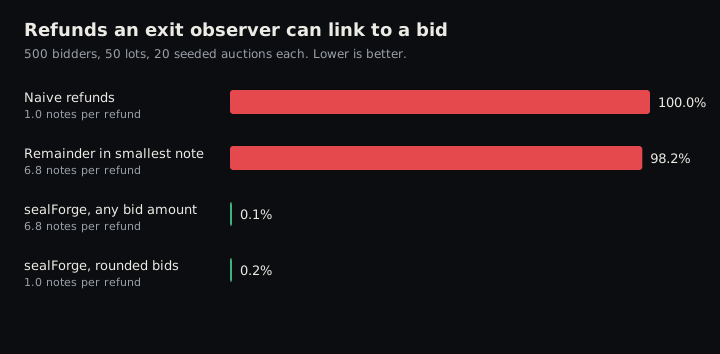
- “Linked”. A bid is linked when at least one of its refund notes has a value no other refund note in that auction has. The observer can then attribute that exit to that bid with certainty.
- Timing is not modelled. Every note has an independent random delay, so arrival time carries no per-bid signal. In the naive flow, amounts already link about 100%.
- Population. Log-normal bids around a 0.5 ZEC median (σ = 1.0), uniform price, seeded and reproducible (
results_are_reproducible_for_a_seed). Default 500 bidders, 50 lots, 20 auctions per scenario.
 Results and other sizes are in evidence/linkability.md (raw:
linkability.json). The harness asserts the PRD target of under 5% (sealforge_meets_the_ac13_target_and_naive_does_not).
The rejected variant. Adding the remainder to the smallest note made one note per refund a unique value, so nearly every refund was linkable again. That’s why dust is dropped rather than merged (evidence/linkability.md §What we learned).
Known residuals
- Exit all at once. A bidder who exits all their notes together recreates the full refund amount and can be linked. The exit path SHOULD warn about this. ShieldRamp, where that warning would live, is not built.
- Rare large refunds in small auctions. An unusually large refund produces a large denomination that may be unique in the auction. This is the residual in the measured figures.
- The bid itself is public after close. The UIVK shows each bid’s amount and refund address. Refund privacy protects the link between a refund exit and a bid, not the bid’s amount.
- Small or quiet pools. Mixing within a batch and delays assume other activity. In an auction with few bidders, or when Ironwood traffic is low, timing analysis across the whole pool is not modelled (11 Open questions).